
30 Best AI Photo Editing Prompts for Boys to Create Cinematic Instagram Portraits in 2026 (By Raj Editing)
AI photo editing prompts for boys work best when they describe a photograph with clear decisions about identity, pose, light, clothes, environment and camera perspective. A vague request such as “make this cinematic” leaves too much to the model; an overloaded request can produce equally poor results because the instructions fight one another. The 30 prompts below are written as complete portrait briefs for Instagram-style images, with different moods and locations rather than the same prompt repeated with a new shirt color. They also include identity-preservation and realism instructions so the result has a better chance of looking like the supplied person instead of a generic AI character.
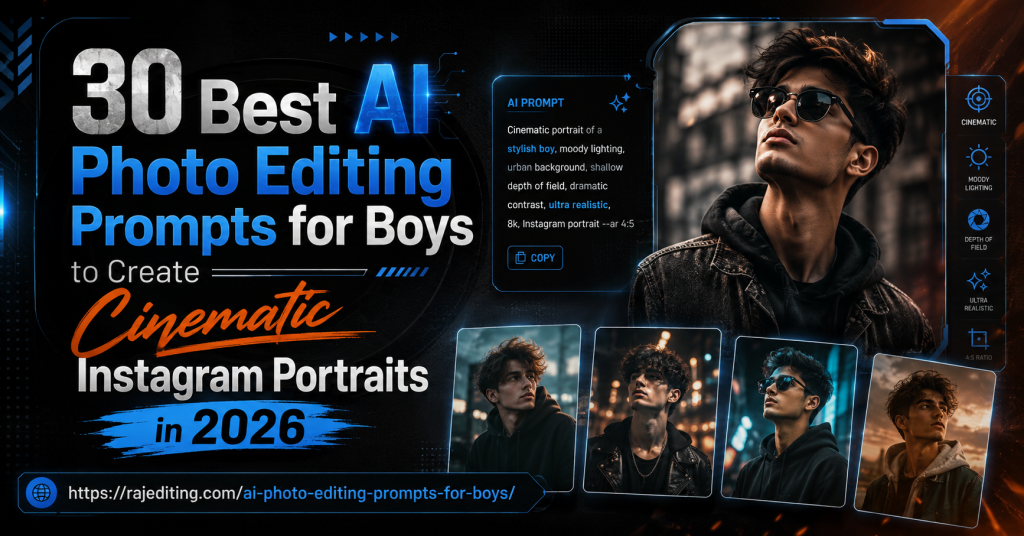
30 Copy-Paste AI Photo Editing Prompts for Boys
These prompts are complete portrait briefs. Replace only the details you actually want to change and keep the identity-preservation instructions when a real person is being edited.
Keep the Person Recognizable When Using AI
This is the practical core of AI photo editing prompts for boys: A portrait prompt gets more reliable when reference image, identity preservation and facial structure are explicit. Tell the model what must remain unchanged before describing style. If a reference image is available, identity preservation should take priority over clothing, background or cinematic effects.
Then shape the photograph with skin texture and wardrobe. Describe light direction and camera relationship rather than piling on adjectives such as “ultra cinematic.” When a result fails, change one variable at a time; otherwise it becomes impossible to know whether the problem came from pose, lens perspective, scene complexity or conflicting instructions.
A Strong Portrait Prompt Has Five Visual Decisions
A portrait prompt gets more reliable when facial structure, skin texture and wardrobe are explicit. Tell the model what must remain unchanged before describing style. If a reference image is available, identity preservation should take priority over clothing, background or cinematic effects.
Then shape the photograph with pose and lighting direction. Describe light direction and camera relationship rather than piling on adjectives such as “ultra cinematic.” When a result fails, change one variable at a time; otherwise it becomes impossible to know whether the problem came from pose, lens perspective, scene complexity or conflicting instructions.
How to Control Skin, Hands, Clothes and Backgrounds
A portrait prompt gets more reliable when wardrobe, pose and lighting direction are explicit. Tell the model what must remain unchanged before describing style. If a reference image is available, identity preservation should take priority over clothing, background or cinematic effects.
Then shape the photograph with camera angle and lens perspective. Describe light direction and camera relationship rather than piling on adjectives such as “ultra cinematic.” When a result fails, change one variable at a time; otherwise it becomes impossible to know whether the problem came from pose, lens perspective, scene complexity or conflicting instructions.
Turn a Good Generation Into an Instagram-Ready Portrait
A portrait prompt gets more reliable when lighting direction, camera angle and lens perspective are explicit. Tell the model what must remain unchanged before describing style. If a reference image is available, identity preservation should take priority over clothing, background or cinematic effects.
Then shape the photograph with depth of field and composition. Describe light direction and camera relationship rather than piling on adjectives such as “ultra cinematic.” When a result fails, change one variable at a time; otherwise it becomes impossible to know whether the problem came from pose, lens perspective, scene complexity or conflicting instructions.
Fix the Most Common AI Portrait Failures
A portrait prompt gets more reliable when lens perspective, depth of field and composition are explicit. Tell the model what must remain unchanged before describing style. If a reference image is available, identity preservation should take priority over clothing, background or cinematic effects.
Then shape the photograph with negative instructions and Instagram crop. Describe light direction and camera relationship rather than piling on adjectives such as “ultra cinematic.” When a result fails, change one variable at a time; otherwise it becomes impossible to know whether the problem came from pose, lens perspective, scene complexity or conflicting instructions.
Related Raj Editing Guides
Related Raj Editing guides that genuinely overlap with this topic are Picsart background change, Lightroom moody presets and InVideo AI tutorial.
Frequently Asked Questions
How do I keep my face unchanged in an AI portrait?
For AI Editing, when answering ‘How do I keep my face unchanged in an AI portrait?’, the practical answer depends on the source media and the version of the app you are using. In this article, the most relevant checks are reference image and identity preservation. If identity matters, use a clear reference image and explicitly preserve facial structure, skin tone and proportions before describing the visual style.
Why does an AI prompt change skin tone or facial structure?
For AI Editing, when answering ‘Why does an AI prompt change skin tone or facial structure?’, treat this as a workflow decision rather than a rule that applies to every project. In this article, the most relevant checks are facial structure and skin texture. If identity matters, use a clear reference image and explicitly preserve facial structure, skin tone and proportions before describing the visual style.
Should I mention a camera lens in every portrait prompt?
For AI Editing, when answering ‘Should I mention a camera lens in every portrait prompt?’, start with the simplest version that solves the visual problem, then add complexity only when it improves the result. In this article, the most relevant checks are wardrobe and pose. If identity matters, use a clear reference image and explicitly preserve facial structure, skin tone and proportions before describing the visual style.
How can I fix AI-generated hands?
For AI Editing, when answering ‘How can I fix AI-generated hands?’, for this search intent, the safest approach is to check the current control in your installed app and judge the output itself. In this article, the most relevant checks are lighting direction and camera angle. If identity matters, use a clear reference image and explicitly preserve facial structure, skin tone and proportions before describing the visual style.
What prompt wording helps realistic skin texture?
For AI Editing, when answering ‘What prompt wording helps realistic skin texture?’, a good result comes from matching the tool to the material instead of forcing the same setting onto every edit. In this article, the most relevant checks are lens perspective and depth of field. If identity matters, use a clear reference image and explicitly preserve facial structure, skin tone and proportions before describing the visual style.
Can I use these prompts without a reference photo?
For AI Editing, when answering ‘Can I use these prompts without a reference photo?’, the feature can help, but it does not remove the need to inspect timing, crop, edges, audio or color in the finished file. In this article, the most relevant checks are composition and negative instructions. If identity matters, use a clear reference image and explicitly preserve facial structure, skin tone and proportions before describing the visual style.
What aspect ratio works for Instagram portraits?
For AI Editing, when answering ‘What aspect ratio works for Instagram portraits?’, use the current official app/help page for availability, then apply the technique according to your own footage or photo. In this article, the most relevant checks are Instagram crop and reference image. If identity matters, use a clear reference image and explicitly preserve facial structure, skin tone and proportions before describing the visual style.
How many prompt changes should I make between generations?
For AI Editing, when answering ‘How many prompt changes should I make between generations?’, think about what the viewer needs to notice first; that usually tells you whether the feature is necessary. In this article, the most relevant checks are identity preservation and facial structure. If identity matters, use a clear reference image and explicitly preserve facial structure, skin tone and proportions before describing the visual style.